Nashville Suburbs on the Rise: 10 Best Places to Buy a Home in 2026 (Proven Picks)
Nashville suburbs on the rise in 2026: home prices, schools, commutes, and growth in 10 Tennessee towns from Franklin to Spring Hill and Mt. Juliet.

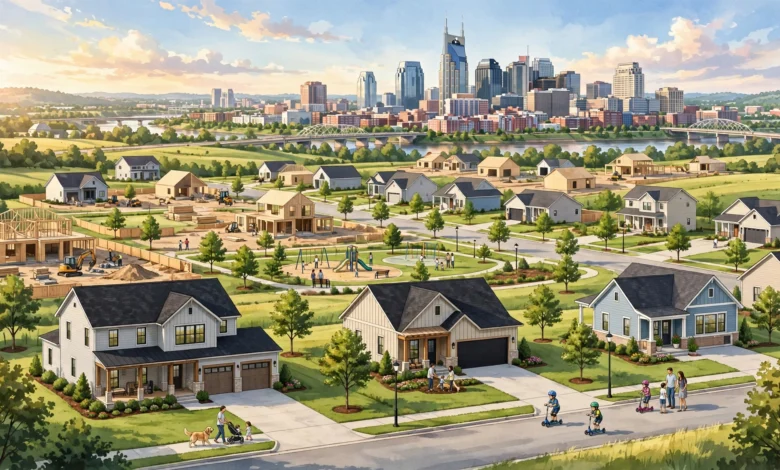
Nashville suburbs have become some of the most talked-about places to buy a home in the South. Over the past decade, Music City has turned into a magnet for corporate relocations, remote workers, and families leaving higher-cost states. As prices inside the city climbed, a lot of that demand spilled outward into the towns that ring Davidson County.
The result is a wave of growth across Middle Tennessee. Farmland has turned into new subdivisions, small-town main streets have filled with restaurants and boutiques, and school districts that were once local secrets now show up on national rankings. Some of these communities are already well known and expensive. Others are still catching up and may offer better value for buyers who get in now.
This Tennessee property guide breaks down the Nashville suburbs on the rise in 2026. We looked at home prices, population growth, school quality, commute times, and new development to identify the towns worth watching. For each suburb, you will find what it is like to live there, what kind of homes you can expect, and the honest trade-offs.
You will also get a side-by-side comparison table, practical tips for buying in Middle Tennessee, and a look at the challenges that come with fast growth, like traffic and rising property taxes. Whether you are relocating, upsizing, or investing, this guide will help you narrow down where to focus your home search.

Why Nashville Suburbs Are Growing So Fast
The rise of the Nashville suburbs is not an accident. Several forces have been pushing people toward Middle Tennessee for years, and most of them are still in play in 2026.
A Strong Job Market
Nashville’s economy is far bigger than country music. Healthcare is a major employer, led by HCA Healthcare and Vanderbilt University Medical Center, and the region has added large corporate offices and campuses from companies in tech, finance, and logistics. Oracle’s planned riverfront campus and the growth of the Nashville Yards and East Bank districts keep drawing workers to the area. Many of those workers end up buying in the suburbs.
No State Income Tax
Tennessee does not tax wages, which makes a real difference for families moving from California, Illinois, New York, or other high-tax states. The Tennessee Department of Revenue explains the state’s tax structure, which leans on sales tax rather than income tax. Combined with property taxes that are low by national standards, this keeps the overall cost of living competitive.
Space, Schools, and New Homes
Inside Nashville, buyers often pay a premium for smaller lots and older homes. In the suburbs, the same budget can buy a newer house with a yard, a garage, and access to highly rated public schools. Williamson, Wilson, Sumner, and Rutherford counties all have school systems that attract families.
The 2026 Nashville Housing Market
After years of rapid price growth, the Nashville real estate market has shifted toward balance. According to Redfin’s August 2026 Davidson County market update, the median sale price in Nashville was about $476,000, roughly flat from a year earlier, while new listings jumped and months of supply moved above six. Across Middle Tennessee, local market reports show a median sale price near $450,000 in August 2026, with inventory up about 10% year over year.
The suburbs vary widely. Williamson County, home to Franklin and Brentwood, posted a median sale price above $900,000 in August 2026, while counties farther from the city remain far more affordable. For buyers, that means more choices and more room to negotiate than at any point in the last several years.
How We Picked the Nashville Suburbs on the Rise
Not every growing town is a good place to buy. To build this list of the best Nashville suburbs, we weighed six factors that matter to most buyers:
- Growth and momentum: Population growth, new businesses, and planned infrastructure that suggest the area will keep improving.
- Home prices and value: How prices compare with Nashville and with nearby suburbs, and what your money actually buys.
- Schools: The reputation of the county or city school district serving the area.
- Commute: Typical drive time to downtown Nashville and major job centers like Cool Springs and Maryland Farms.
- Lifestyle: Parks, lakes, historic downtowns, dining, and community events.
- Housing supply: Availability of new construction and resale homes across different price points.
We group home prices into tiers relative to the Middle Tennessee median of roughly $450,000: Value (near or below the median), Mid (moderately above), Upper (well above), and Luxury (among the most expensive in the region). Exact prices change monthly, so check current listings for the neighborhoods you like.
10 Nashville Suburbs on the Rise in 2026
These Nashville suburbs range from established favorites to fast-growing towns that are still finding their stride. They are grouped loosely from the most established to the ones with the most room left to grow.
1. Franklin: The Crown Jewel of Williamson County
Franklin, about 20 miles south of Nashville, is often the first suburb people mention. Its historic downtown, with Main Street shops, restaurants, and the restored Franklin Theatre, is one of the most charming in the South. Civil War history, festivals, and a busy events calendar give the town real character.
Franklin is also a major job center in its own right. The Cool Springs area hosts corporate offices for companies in healthcare, automotive, and finance, which means many residents never commute into Nashville at all.
- Schools: Williamson County Schools and Franklin Special School District, both highly rated.
- Homes: Historic homes near downtown, large planned communities like Westhaven, and luxury estates.
- Commute to Nashville: About 25 to 45 minutes depending on traffic on I-65.
- Price tier: Luxury
Pros: Top schools, beautiful downtown, local jobs. Cons: Among the most expensive suburbs in Tennessee; I-65 congestion at rush hour.
2. Brentwood: Close-In Luxury With Big Lots
Brentwood sits just south of the Nashville city line, making it one of the closest high-end suburbs to downtown. It is known for spacious homes on large wooded lots, excellent schools, and a quiet, residential feel. Maryland Farms offers office space and shopping close to home.
- Schools: Williamson County Schools, including Brentwood High and Ravenwood High.
- Homes: Mostly large single-family homes, many on an acre or more.
- Commute to Nashville: About 15 to 30 minutes.
- Price tier: Luxury
Pros: Short commute, top schools, privacy and space. Cons: Very high prices and limited walkable areas.
3. Nolensville: Small-Town Charm With Fast Growth
Nolensville, in the eastern part of Williamson County, has gone from a sleepy village to one of the most popular Nashville suburbs for families. It keeps a small-town historic district while adding new subdivisions, parks, and schools at a fast pace.
- Schools: Williamson County Schools, including Nolensville High School.
- Homes: Mostly newer construction in planned neighborhoods.
- Commute to Nashville: About 30 to 40 minutes.
- Price tier: Upper
Pros: Williamson County schools at somewhat lower prices than Franklin or Brentwood, strong community feel. Cons: Two-lane roads are struggling to keep up with growth.
4. Spring Hill: Room to Grow South of Franklin
Spring Hill straddles Williamson and Maury counties and has grown quickly thanks to large employers like the General Motors manufacturing plant. It offers more affordable new construction than Franklin while staying within reach of Cool Springs.
- Schools: Williamson County Schools on the Williamson side and Maury County Public Schools on the Maury side.
- Homes: Newer single-family homes and townhomes in large subdivisions.
- Commute to Nashville: About 40 to 55 minutes.
- Price tier: Mid to Upper
Pros: Newer homes, better value than Franklin, local jobs. Cons: Long commute to Nashville; check which county and school district a home falls in.
5. Thompson’s Station: Country Space Near Franklin
Thompson’s Station is a small Williamson County town between Franklin and Spring Hill. It offers rolling hills, larger lots, and a quieter, more rural feel while still being close to the amenities of Franklin and Cool Springs. Master-planned communities like Tollgate Village have brought in new homes and parks.
- Schools: Williamson County Schools.
- Homes: New construction, farmhouse styles, and estate lots.
- Commute to Nashville: About 35 to 50 minutes.
- Price tier: Upper
Pros: Space, scenery, top schools. Cons: Few shops and restaurants in town; car-dependent.
6. Mt. Juliet: The East Side’s Rising Star
Mt. Juliet, east of Nashville in Wilson County, has become one of the fastest-growing suburbs of Nashville. Providence Marketplace offers big-name shopping and dining, Old Hickory Lake provides boating and parks, and the Music City Star commuter rail connects to downtown.
- Schools: Wilson County Schools, which are well regarded.
- Homes: A mix of established neighborhoods and new subdivisions, including lake properties.
- Commute to Nashville: About 25 to 40 minutes via I-40.
- Price tier: Mid to Upper
Pros: Good schools, shopping, lake access, close to the airport. Cons: I-40 traffic can be heavy, and growth has strained local roads.
7. Hendersonville: Lakeside Living North of Nashville
Hendersonville sits on the shores of Old Hickory Lake in Sumner County. It has long been known as the “City by the Lake” and has a history as a home for country music stars. Today it offers a wide range of homes, from lakefront estates to affordable starter houses.
- Schools: Sumner County Schools, with several well-rated schools in the area.
- Homes: Older ranches, newer subdivisions, and luxury lakefront homes.
- Commute to Nashville: About 25 to 40 minutes via Vietnam Veterans Boulevard and I-65.
- Price tier: Mid
Pros: Lake lifestyle, broad price range, established amenities. Cons: Commute bottlenecks on the main routes into Nashville.
8. Gallatin: Historic Downtown With Value
Gallatin, the Sumner County seat, is a little farther from the city than Hendersonville but offers more value and a revitalized historic downtown square. New businesses, restaurants, and employers have helped turn it into one of the up-and-coming Nashville suburbs.
- Schools: Sumner County Schools.
- Homes: Historic homes, new subdivisions, and lake access on Old Hickory.
- Commute to Nashville: About 35 to 50 minutes.
- Price tier: Value to Mid
Pros: More home for the money, charming downtown, growing job base. Cons: Longer commute and fewer big-box options than closer suburbs.
9. Lebanon: Affordable Growth East of Mt. Juliet
Lebanon, also in Wilson County, is drawing buyers priced out of Mt. Juliet. It has a historic square, Cumberland University, and easy access to I-40. Large distribution centers and new employers have added jobs, and new subdivisions are going up quickly.
- Schools: Lebanon Special School District for younger grades and Wilson County Schools.
- Homes: Affordable new construction and older homes near the square.
- Commute to Nashville: About 35 to 50 minutes.
- Price tier: Value
Pros: Lower prices, room to grow, small-town character. Cons: Longer drive and fewer amenities than Mt. Juliet.
10. Murfreesboro: A City of Its Own
Murfreesboro, about 35 miles southeast of downtown, is one of the largest and fastest-growing cities in Tennessee. Home to Middle Tennessee State University, it has its own job market, shopping, and entertainment, so many residents rarely need to go into Nashville. It is a strong option for buyers who want city amenities at lower prices.
- Schools: Murfreesboro City Schools and Rutherford County Schools.
- Homes: Everything from starter homes to new luxury subdivisions.
- Commute to Nashville: About 40 to 60 minutes via I-24.
- Price tier: Value to Mid
Pros: Affordable, plenty of amenities, strong job base. Cons: I-24 is one of the most congested commutes in the region.
Nashville Suburbs Compared Side by Side
This table summarizes the Nashville suburbs on the rise so you can compare them quickly. Commute times are typical ranges to downtown Nashville and change with traffic.
| Suburb | County | Price tier | Commute to Nashville | School system | Best for |
|---|---|---|---|---|---|
| Franklin | Williamson | Luxury | 25 to 45 min | Williamson County / Franklin SSD | Historic charm, local jobs |
| Brentwood | Williamson | Luxury | 15 to 30 min | Williamson County | Short commute, big lots |
| Nolensville | Williamson | Upper | 30 to 40 min | Williamson County | Families wanting top schools |
| Thompson’s Station | Williamson | Upper | 35 to 50 min | Williamson County | Space and scenery |
| Spring Hill | Williamson / Maury | Mid to Upper | 40 to 55 min | Williamson or Maury County | New construction value |
| Mt. Juliet | Wilson | Mid to Upper | 25 to 40 min | Wilson County | Shopping, lake, airport access |
| Hendersonville | Sumner | Mid | 25 to 40 min | Sumner County | Lake lifestyle |
| Gallatin | Sumner | Value to Mid | 35 to 50 min | Sumner County | Value and historic downtown |
| Murfreesboro | Rutherford | Value to Mid | 40 to 60 min | Murfreesboro City / Rutherford County | City amenities, affordability |
| Lebanon | Wilson | Value | 35 to 50 min | Lebanon SSD / Wilson County | Lowest entry prices |
Quick Picks by Buyer Type
- Top schools, budget allows: Franklin, Brentwood, or Nolensville
- Best value with good schools: Mt. Juliet, Hendersonville, or Spring Hill
- Most affordable entry point: Lebanon, Gallatin, or Murfreesboro
- Lake lovers: Hendersonville, Gallatin, or Mt. Juliet
- Shortest commute: Brentwood
Tips for Buying a Home in the Nashville Suburbs
Buying in Middle Tennessee real estate has its own rhythm. These tips will help you avoid common mistakes as you shop the Nashville suburbs.
1. Check the School Zone, Not Just the Town
Town names do not always match school districts. A home with a Franklin mailing address might be zoned for a different school than you expect, and Spring Hill homes can fall in either Williamson or Maury County. Always confirm school zoning with the district using the exact address.
2. Understand Tennessee Property Taxes
Tennessee property taxes are set by each county and, in some cases, each city. Residential property is assessed at 25% of appraised value, and then the local tax rate is applied. Counties reappraise on a regular cycle, so a tax bill can jump after a reappraisal year. Look up the actual tax history on the county assessor’s site before you buy.
3. Weigh New Construction Carefully
Many Nashville suburbs are full of new subdivisions. New homes offer modern layouts and fewer repairs, but keep these points in mind:
- Builder incentives, like rate buydowns or closing cost help, are more common in a balanced market, so ask for them.
- Hire your own inspector, even for a brand-new home.
- Read the HOA rules and fees carefully.
- Ask about future phases, nearby land, and planned road work that could change the area.
4. Test Your Commute at Rush Hour
I-65, I-24, and I-40 can all slow to a crawl at peak times. Before you commit, drive your actual commute on a weekday morning and evening. A home that is 25 miles away might take 30 minutes or 75 depending on the route and time.
5. Use the Balanced Market to Your Advantage
With inventory up and more price cuts in 2026, buyers have more leverage in the Nashville real estate market than in recent years. You may be able to negotiate on price, ask for repairs, or request seller concessions. A local agent can tell you how flexible sellers are in each suburb.
6. Think About Resale
Even if you plan to stay for years, consider who will buy your home later. Homes in strong school zones, close to job centers, and with reasonable HOA fees usually hold value best.
Challenges of Living in Fast-Growing Nashville Suburbs
Rapid growth brings real benefits, but it also creates problems. Go in with your eyes open.
- Traffic: Road expansion has not kept up with population growth in many Nashville suburbs. Commutes that were easy five years ago can now be frustrating.
- School crowding: Some fast-growing districts have used portable classrooms while new schools are built, and zoning lines can change as new schools open.
- Rising property taxes: Growing towns need new schools, roads, and services, which can lead to higher tax rates or bigger bills after reappraisal.
- Loss of small-town feel: Long-time residents in places like Nolensville and Spring Hill have watched farmland turn into subdivisions. If quiet countryside is what you want, it may not stay that way.
- Weather risks: Middle Tennessee sees severe storms and occasional tornadoes, and some low-lying areas carry flood risk. Check flood maps and budget for insurance.
- Market cooling: Prices in some areas dipped slightly over the past year. If you might need to sell within a few years, factor in the chance of flat or falling prices.
None of these are reasons to avoid the suburbs, but they are reasons to research each town and neighborhood carefully before you buy.
Up-and-Coming Nashville Suburbs to Watch Next
Beyond the top 10, a handful of smaller towns are starting to attract buyers who are priced out of the better-known Nashville suburbs. They are earlier in their growth, which can mean lower prices and more risk.
- Columbia: About 45 miles south of Nashville in Maury County, Columbia has a lively historic square, a growing restaurant scene, and new subdivisions. It is a favorite for buyers who want small-town life with a reasonable drive to Franklin and Nashville.
- Smyrna: Between Nashville and Murfreesboro, Smyrna is anchored by the Nissan plant and offers good value with quick access to I-24 and the Nashville airport.
- White House: North of Nashville on I-65, White House offers newer homes and a quieter pace while keeping the drive to Nashville manageable.
- Fairview: West of Nashville in Williamson County, Fairview gives buyers access to Williamson County Schools at lower prices than Franklin, with plenty of wooded land.
- Pleasant View and Springfield: These Robertson County towns northwest and north of Nashville offer some of the most affordable new homes within commuting range of Nashville.
These towns may not have the amenities of the larger Nashville suburbs yet, but they are worth watching if you want to buy before the next wave of growth arrives.
Frequently Asked Questions About Nashville Suburbs
What is the best suburb of Nashville to live in?
Franklin and Brentwood are often ranked at the top for schools, amenities, and home values. If you want more value, Mt. Juliet, Hendersonville, and Nolensville are strong choices.
What is the most affordable Nashville suburb?
Lebanon, Gallatin, and Murfreesboro tend to offer the lowest entry prices among the Nashville suburbs on this list, while still providing good access to jobs and amenities.
Which Nashville suburbs have the best schools?
Suburbs served by Williamson County Schools, including Franklin, Brentwood, Nolensville, and Thompson’s Station, consistently rank among the best in Tennessee. Wilson County and Sumner County schools are also well regarded.
Is it a good time to buy in the Nashville suburbs in 2026?
The market is more balanced than in recent years, with more inventory and more price cuts. That gives buyers better negotiating power, but prices in top suburbs remain high. The right time depends on your budget, rate, and how long you plan to stay.
How long is the commute from the suburbs to Nashville?
It ranges from about 15 minutes from Brentwood to an hour or more from Murfreesboro or Spring Hill at rush hour. Always test the drive at peak times.
Does Tennessee have a state income tax?
No. Tennessee does not tax wages, which is one reason so many people relocate to Nashville and its suburbs. The state relies more on sales tax, which is relatively high.
Conclusion
The Nashville suburbs on the rise in 2026 give buyers a wide range of choices, from the luxury streets of Franklin and Brentwood to the fast-growing family communities of Nolensville, Thompson’s Station, and Spring Hill, and the better-value options in Mt. Juliet, Hendersonville, Gallatin, Lebanon, and Murfreesboro. Strong job growth, no state income tax, good schools, and newer homes keep drawing people to Middle Tennessee, while a more balanced housing market, with a regional median near $450,000 and rising inventory, gives buyers more room to negotiate than they have had in years. Growth also brings traffic, crowded schools, and rising property taxes, so confirm school zones by address, test your commute at rush hour, check real tax bills, and weigh new construction carefully. Do that homework, and you will be in a strong position to find the Nashville suburb that fits your budget, your lifestyle, and your long-term plans.