Gold Coast Real Estate: Queensland’s Hottest Market Explained, 6 Powerful Reasons Prices Keep Climbing in 2026
Gold Coast real estate: Queensland's hottest market explained, from record prices and tight vacancy to the Olympics infrastructure boom.

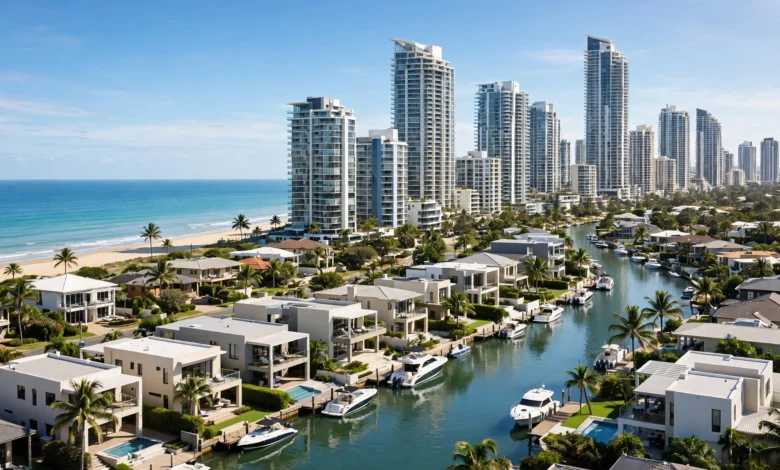
Gold Coast real estate: Queensland’s hottest market explained starts with a number that would have seemed unthinkable a decade ago: the Gold Coast’s median unit price overtook Sydney’s for the first time in history in late 2025, according to Ray White data, reaching $956,000 compared to Sydney’s $927,000, a 101% increase over just ten years. House prices tell a similarly dramatic story, with the median now sitting somewhere between $1.17 million and $1.35 million depending on the data source, comfortably placing the Gold Coast among Australia’s most expensive property markets outside Sydney and Melbourne.
What makes this genuinely remarkable is how recently the Gold Coast was considered a firmly “affordable coastal” market. Just five years ago, buyers priced out of Brisbane or Sydney routinely looked to the Gold Coast for relative value. That’s no longer the case. House prices have roughly doubled since 2019, rental vacancy sits below 1.5% across most of the city, and annual price growth has run as high as 13.9% to 15.2% over the past year depending on the specific measure used.
This article breaks down exactly why the Gold Coast has become Queensland’s hottest property market, the specific data behind the price surge, the infrastructure and population forces driving demand, the genuine supply crisis limiting new construction, and what buyers, sellers, and investors should realistically expect heading into the rest of 2026 and beyond. Whether you’re considering a purchase, tracking the market for investment purposes, or just curious how a once-affordable coastal city became one of the country’s priciest, here’s the complete, current picture.
Gold Coast Real Estate: The Numbers Behind the Boom
Because multiple data providers track Gold Coast property using different methodologies, geographic boundaries, and update schedules, the exact median price you’ll see varies meaningfully depending on the source. Here’s a range of the current figures being reported through 2026:
| Source | Median House Price | Annual Growth |
|---|---|---|
| Cotality (Regional Market Update) | $1.17 million | +10–12% |
| PropTrack Home Price Index | $1.18 million | Slight monthly easing mid-2026 |
| Ray White | $1.32 million | +8.5% (2025) |
| Bamboo Routes forecast | $1.35 million | +7–10% |
| HTAG Analytics (Typical House Price) | $1.74 million | +13.9% (year to June 2026) |
| Fields Estate | $1.4–1.5 million | Stable, consolidation phase |
The spread here reflects genuine methodological differences, some measures track the entire Gold Coast local government area while others focus on specific high-value pockets, and “typical house price” calculations can differ meaningfully from straightforward median sale price tracking. Despite the variation, every source agrees on the underlying trend: the Gold Coast has posted strong, sustained annual growth, and the city’s overall price level has climbed well beyond what most Australians would have associated with the region a decade ago.
Units tell an equally compelling story. The median Gold Coast unit price has climbed to somewhere between $795,000 and $956,000 depending on the source, with unit price growth in some measures outpacing houses, running 9% to 14% annually compared to 7% to 10% for detached homes, as buyers priced out of the house market increasingly target apartments instead.
Why Gold Coast Real Estate Has Become Queensland’s Hottest Market
Several structural forces have converged to push the Gold Coast property market to the top of Queensland’s growth rankings, and understanding each one helps explain why this isn’t simply a temporary post-pandemic spike.
1. Relentless Population Growth
The Gold Coast continues adding roughly 15,000 new residents annually, one of the largest population increases of any local government area in Queensland. This sustained inflow keeps consistent upward pressure on housing demand, regardless of short-term fluctuations in interest rates or broader economic sentiment.
2. A Genuine, Worsening Supply Shortage
The South East Queensland Regional Plan calls for approximately 4,500 new dwellings per year on the Gold Coast to meet demand. The city is delivering a fraction of that figure. The Property Council of Australia has flagged that new apartment completions could fall from around 1,900 units in 2025 to just 1,400 in 2026, with only about 50 units considered relatively certain for delivery in 2027. Coastal land is effectively built out, new development approvals face delays from planning bottlenecks and rising construction costs, and Queensland-wide dwelling approvals are currently running roughly 5% below the five-year average.
3. Olympic and Major Infrastructure Investment
Queensland’s decade-long pipeline of infrastructure investment tied to the 2032 Brisbane Olympics, combined with regional projects like the Coomera Connector and the Gold Coast Light Rail Stage 3 extension to Burleigh Heads, has directly lifted property demand along specific corridors. The Light Rail extension in particular is already boosting demand along the southern coastal strip from Broadbeach to Palm Beach ahead of its expected mid-2026 completion.
4. Extremely Tight Rental Vacancy
Rental vacancy across the Gold Coast sits under 1.5%, with some measures placing it below 1%, among the tightest rental markets in the country. This scarcity keeps rents climbing (roughly $780 per week for houses and $600 for units, according to recent quarterly rental data) and continues attracting investors specifically targeting the strong, sustained rental yield story.
5. Interstate and Lifestyle-Driven Migration
Much of the Gold Coast’s population growth stems from interstate migration, buyers and renters relocating from Sydney and Melbourne drawn by comparatively lower prices, warmer weather, and a lifestyle-focused coastal identity, even as the region’s own prices have climbed dramatically closer to those benchmark cities.
6. Scarcity-Driven Demand in Blue-Chip Coastal Suburbs
Suburbs like Mermaid Beach and Broadbeach Waters have led recent growth specifically on scarcity and lifestyle appeal, while gated luxury communities such as Sanctuary Cove remain strong performers at the top end of the market. This concentration of demand in specific, supply-constrained pockets has helped pull the citywide median higher even as growth varies considerably suburb to suburb.
How the Gold Coast Compares to Other Queensland Markets
Placing the Gold Coast alongside its regional Queensland peers helps clarify just how much of an outlier its growth has become.
- Brisbane recorded dwelling values rising 1.2% in a single month and 3.2% over the quarter as of April 2026, a strong result but notably more moderate than the Gold Coast’s pace.
- The Sunshine Coast is forecast for 10% to 15% growth in 2026, supported specifically by the Maroochydore CBD development, running close behind the Gold Coast’s own forecast range.
- Toowoomba offers a dramatically more affordable entry point, with a median around $600,000 to $800,000, though certain suburbs have posted growth exceeding 24% annually.
- Cairns delivers some of the state’s strongest rental yields, in the 4.7% to 5.0% range with some suburbs reaching 6.9%, a meaningfully different investment profile than the Gold Coast’s more growth-focused, lower-yield market.
- The broader Queensland Residential Property Price Index rose 8.1% over the past year according to ABS data, meaning the Gold Coast’s 10% to 15% growth sits comfortably above the state average, confirming its position as the standout performer within Queensland’s broader property boom.
Is the Gold Coast Property Boom Sustainable?
This is the question every serious buyer and investor needs to weigh honestly before committing capital to the Gold Coast real estate market at current price levels.
Arguments for continued strength:
- Population growth of roughly 15,000 people annually shows no clear signs of slowing
- The structural supply shortfall, delivering roughly 1,400 to 1,900 new apartments against a required 4,500 dwellings annually, isn’t likely to resolve quickly given planning and construction cost constraints
- Major infrastructure investment tied to the 2032 Olympics provides a multi-year demand tailwind that extends well beyond typical short-term market cycles
- Rental vacancy under 1.5% gives landlords and investors continued pricing power, supporting both yields and capital values
Reasons for caution:
- The Gold Coast’s median house price has now overtaken every Australian capital city except Sydney, a genuinely significant shift that raises legitimate affordability questions for local buyers
- Several data sources note the market has moved from a “boom” phase into a “steady growth” or “consolidation” phase, with days on market rising from roughly 14 to 23 days year-over-year in some measures and PropTrack recording a slight monthly price easing in mid-2026, the first such easing in almost four years
- Most major bank forecasts for 2026 point to a more moderate 4% to 7% growth range, well below the double-digit gains of the past two years
- Gross rental yields on houses have compressed to around 2.76% to 4.3% depending on the specific measure, below the commonly recommended 3% threshold in some pockets, indicating the market increasingly favors capital growth strategies over cashflow-focused investing
The consensus across most current forecasts is that the Gold Coast is transitioning from rapid, double-digit boom-phase growth into a steadier, more moderate expansion, still positive, but no longer accelerating at the pace seen through 2024 and into early 2026.
What Buyers Should Know About Gold Coast Real Estate Right Now
Given the mix of continued fundamentals and moderating price momentum, here’s what prospective buyers should factor into their decision-making.
- Treat the Gold Coast as multiple distinct markets, not one. Professional buyers agents working South East Queensland reportedly treat the Gold Coast as eleven or more separate submarkets, since suburb-level performance varies dramatically from the citywide headline figures.
- Check cycle position before paying peak-of-cycle prices. With growth already running well above the city’s own long-run average (11.1% annually over three years, 10.9% over five), understanding where a specific suburb sits in its own cycle matters more than chasing the citywide median.
- Consider units if house prices feel out of reach. With median house prices now exceeding $1.3 million in several measures, buyers priced out of detached housing are increasingly targeting units, a trend that’s helped drive stronger unit price growth in several pockets of the market.
- Watch infrastructure corridors specifically. Areas along the Gold Coast Light Rail Stage 3 extension and the Coomera Connector route are seeing amplified demand tied directly to improved transport access, a pattern likely to continue as these projects near completion.
- Factor in longer selling and buying timelines than in recent years. Days on market have lengthened in several measures, giving buyers somewhat more room to negotiate and conduct due diligence than during the sharpest growth period.
For readers who want to track suburb-level Gold Coast data directly, Cotality’s regional market updates provide regularly published price and rental trend data across Queensland, while the Queensland Government’s South East Queensland Regional Plan outlines the specific dwelling supply targets and infrastructure priorities shaping the region’s long-term growth trajectory.
What This Means for Sellers and Investors
For sellers:
- Current conditions still favor sellers in well-located, supply-constrained suburbs, though longer days on market compared to the peak growth period mean realistic pricing matters more than it did eighteen months ago
- Blue-chip coastal suburbs with genuine scarcity value, such as Mermaid Beach and Broadbeach Waters, continue commanding strong buyer interest even as the broader market moderates
For investors:
- Extremely tight rental vacancy (under 1.5% citywide, and under 1% in some measures) continues supporting strong, sustained rental demand, even as gross yields have compressed below the 3% threshold in several segments
- The Gold Coast’s positioning as a long-term capital growth market, rather than a high-yield cashflow play, should shape investment strategy and financing decisions accordingly
- Infrastructure-adjacent suburbs tied to Olympic-related investment and the Light Rail extension represent some of the more compelling medium-term growth opportunities within the broader market
Frequently Asked Questions
What is the median house price on the Gold Coast in 2026?
Estimates range from roughly $1.17 million (Cotality) to $1.74 million (HTAG’s “Typical House Price” measure), with most major sources converging somewhere between $1.18 million and $1.35 million, reflecting differences in methodology and geographic scope.
Why is the Gold Coast Queensland’s hottest property market?
The Gold Coast combines relentless population growth of roughly 15,000 residents annually, a severe and worsening housing supply shortfall, major infrastructure investment tied to the 2032 Olympics and Light Rail expansion, and rental vacancy under 1.5%, a combination that has pushed price growth well above Brisbane, the Sunshine Coast, and the broader Queensland average.
Has the Gold Coast property market peaked?
Most current data suggests the market has moved from a rapid “boom” phase into a steadier “consolidation” phase, with days on market lengthening and PropTrack recording a slight monthly price easing in mid-2026, though most forecasters still expect positive growth of 4% to 7% through the remainder of the year rather than a decline.
Is the Gold Coast still a good place to invest in property?
The Gold Coast continues to offer strong long-term capital growth fundamentals given tight supply and sustained population growth, though gross rental yields have compressed below the commonly recommended 3% threshold in several segments, making it better suited to growth-focused investors than those prioritizing immediate cashflow.
Conclusion
Gold Coast real estate: Queensland’s hottest market explained comes down to a rare alignment of forces rarely seen together for this long: population growth of roughly 15,000 people a year, a housing supply pipeline delivering barely a third of the dwellings the region actually needs, and multi-year infrastructure investment tied to the 2032 Olympics and major transport upgrades, all combining to push the city’s median unit price past Sydney’s for the first time in history and its house prices to levels once unthinkable for a market long considered Australia’s affordable coastal alternative. The most recent data suggests this boom is now maturing into a steadier, more moderate growth phase rather than reversing outright, with days on market lengthening and most bank forecasts settling into a more sustainable 4% to 7% range for the rest of 2026. For buyers, sellers, and investors alike, the Gold Coast’s story going forward will likely be less about chasing the next double-digit surge and more about identifying which of its eleven-plus distinct submarkets still offer genuine value as the broader market settles into a new, considerably more expensive normal.