Best NJ Towns for NYC Commuters: 9 Proven New Jersey Property Picks for 2026
Best NJ towns for NYC commuters: real train times, home prices, and lifestyle details for Hoboken, Montclair, Summit, and more.

Best NJ towns for NYC commuters are the first thing most people search when they realize their New York rent isn’t sustainable anymore. If you’re weighing a move across the Hudson, you already know the drill: you want a shorter commute, a bigger home, and a downtown that doesn’t feel like a parking lot. What you probably don’t know yet is which towns actually deliver on all three at once, because most guides just repeat the same five names without explaining the trade-offs.
This guide breaks it down honestly. Some New Jersey commuter towns get you into Manhattan in under 15 minutes but charge Manhattan-adjacent prices for the privilege. Others give you a bigger yard and a better school district in exchange for a 50-minute train ride. There’s no universal “best” here, only the town that fits your budget, your commute tolerance, and the kind of life you want when you’re not on a train.
Below, you’ll find nine towns organized by transit type: PATH and ferry towns for the fastest rides, Midtown Direct suburbs for families who want space, and a couple of under-the-radar options for buyers who want value without giving up access. Each section covers commute time, general price range, and what daily life actually looks like there.
How to Choose a New Jersey Commuter Town
Before jumping into specific towns, it helps to know what actually separates a good pick from a bad one. Real estate agents working with NYC transplants typically weigh four things:
- Direct train service — A one-seat ride beats a transfer every single time, especially in bad weather or during service disruptions.
- Frequency — Trains running every 15–30 minutes during rush hour matter more than the headline commute time if you ever miss your usual train.
- Door-to-door reality — The time printed on the schedule is platform-to-platform. Add walking, parking, or a bus connection to get the real number.
- School quality and walkability — Even commuters without kids benefit from strong school districts, since they hold property values steady.
With that framework in mind, here’s how the best towns for NYC commuters stack up.
PATH and Ferry Towns: Fastest Commutes to Manhattan
If shaving minutes off your commute matters more than square footage, these are your top New Jersey commuter towns.
Hoboken
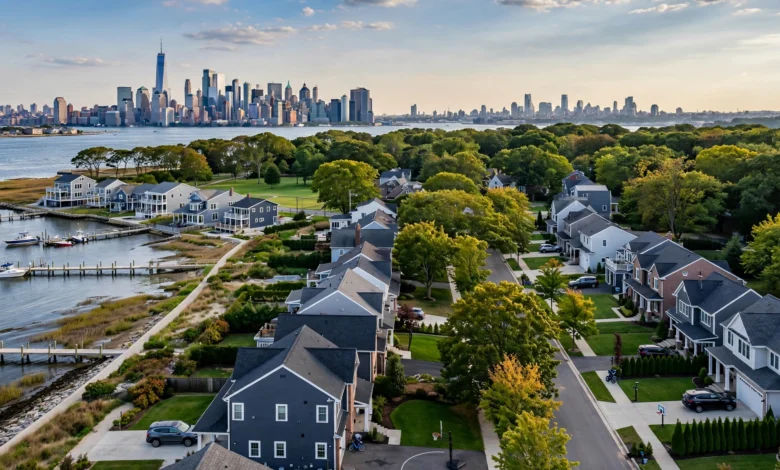
Hoboken is the benchmark every other town gets measured against. The PATH train connects directly to the World Trade Center and Midtown, and during peak hours you can be at your desk in well under 20 minutes. NY Waterway ferries add another fast option if you work closer to the water. You can find official schedules and fare information on the Port Authority Trans-Hudson (PATH) website.
- Commute: 10–20 minutes via PATH or ferry
- Vibe: Dense, walkable, waterfront, heavy on young professionals
- Trade-off: Small square footage for the price, and it’s noisy compared to inland suburbs
Hoboken works best for people who want to keep a city lifestyle but escape Manhattan rent. Walk Score here is among the highest in the state, so plenty of residents skip car ownership entirely.
Jersey City
Jersey City has changed more than almost any other town on this list in the past decade. The Exchange Place and Newport neighborhoods are now packed with high-rise condo towers, multiple PATH stations, and ferry terminals that put Downtown or Midtown Manhattan within a 10 to 30-minute ride depending on where you land.
- Commute: 10–30 minutes via PATH or ferry
- Vibe: Skyline views, new construction, growing restaurant and nightlife scene
- Trade-off: Prices near the waterfront rival Hoboken, though neighborhoods further inland (like Journal Square) are noticeably cheaper
Because Jersey City is so large, it’s worth treating it as several micro-markets rather than one town. Waterfront living costs the most; the areas around Journal Square and the Heights cost meaningfully less while keeping solid transit access.
Weehawken and Jersey City Heights
These two get overlooked because they sit in Hoboken’s shadow, but they offer nearly identical ferry access at a lower price point. The NY Waterway ferry from Weehawken reaches Midtown in about 10–15 minutes, and bus service into Port Authority adds another layer of flexibility for commuters heading further into the city.
Midtown Direct Suburbs: Best for Families and Space
If you’re prioritizing a yard, a stronger school district, or just more square footage, the Midtown Direct line on NJ Transit is where most buyers end up. These trains run straight into New York Penn Station without a transfer, which is a big deal for anyone who’s ever had to change trains at Newark during a summer heat wave. You can check current fares, monthly pass pricing, and schedules on the NJ Transit website.
Montclair
Montclair blends small-city energy with suburban living better than almost anywhere else on this list. It has multiple train stations depending on which neighborhood you settle in, an active arts scene anchored by the Montclair Art Museum, and one of the more diverse populations in Essex County.
- Commute: Roughly 35–45 minutes to Midtown
- Vibe: Creative, walkable downtown, strong restaurant scene
- Best for: Families who want culture without sacrificing school quality
Maplewood
Maplewood has built a reputation as the value play among the top-tier commuter suburbs. It sits on the Midtown Direct line with a commute around 30 minutes, and it consistently offers more home for the money than neighboring Summit or Millburn.
- Commute: About 30 minutes via Midtown Direct
- Vibe: Artsy, diverse, tight-knit community with a genuinely good downtown restaurant strip
- Best for: Young families and buyers who want Summit-level transit without Summit-level pricing
Maplewood shares its high school, Columbia High School, with neighboring South Orange, and the district’s arts programs are consistently well regarded.
South Orange
South Orange is Maplewood’s neighbor in almost every sense: same train line, same school district, similar Victorian housing stock, and a similarly strong sense of community. The commute runs about 35 minutes, and the town has built a reputation for inclusivity and a walkable downtown centered around Seton Hall University.
- Commute: Around 35 minutes via Midtown Direct
- Vibe: Historic homes, active arts scene, welcoming community
- Best for: Buyers who want everything Maplewood offers with a slightly different neighborhood feel
Summit
Summit sits toward the premium end of the market, but it earns that price tag. It combines one of the fastest express commutes on the Midtown Direct line, around 40–44 minutes, with a top-ranked school district and a genuinely upscale downtown full of boutiques and restaurants.
- Commute: 40–44 minutes, with frequent express trains
- Vibe: Polished, historic, family-oriented
- Best for: Executives and families prioritizing schools who can absorb a higher price point
Westfield
Westfield rounds out the premium Midtown Direct tier. The commute runs closer to 50 minutes, which is longer than Summit’s, but the town’s gas-lamp downtown, strong schools, and classic New Jersey suburban feel keep it in high demand year after year.
- Commute: Around 50 minutes to Penn Station
- Vibe: Small-town warmth, upscale amenities, tree-lined streets
- Best for: Families prioritizing schools and downtown walkability over shaving off commute minutes
Value-Focused Commuter Towns
Not every buyer wants or can afford the premium inner-ring suburbs. These towns still deliver solid NYC commuter access at a noticeably lower price.
Rutherford (Bergen County)
Rutherford is Bergen County’s quiet standout. It offers roughly a 27-minute ride to Penn Station via the Bergen Line, a genuinely walkable downtown along Park Avenue, and prices well below the northern Bergen County towns like Tenafly or Ridgewood.
- Commute: About 27 minutes via NJ Transit
- Vibe: Small-town charm, older character homes, real community feel
- Best for: Buyers who want the shortest possible Bergen County commute on a tighter budget
Cranford
Cranford runs on the Raritan Valley Line, which requires a transfer at Newark rather than a one-seat ride, but the trade-off shows up in the price. It’s one of the more affordable towns within a reasonable commute distance, with starter condos and Capes available below the price floor of most Midtown Direct suburbs.
- Commute: Around 60 minutes including the transfer
- Vibe: Family-friendly, active downtown, strong sense of community
- Best for: Buyers stretching every dollar who are willing to trade a one-seat ride for affordability
Metuchen
Metuchen, in Middlesex County, delivers a walkable downtown and express train service on the Northeast Corridor line, which makes it a favorite among Central Jersey buyers who still want a genuine town center rather than a car-dependent development.
- Commute: Roughly 40–50 minutes with express service
- Vibe: Compact downtown, restaurants and shops within walking distance
- Best for: Buyers who want a true walkable Main Street without North Jersey pricing
Understanding NJ Transit and Commute Costs
A few practical numbers help put all of this in context. Monthly peak passes on most NJ Transit commuter lines run in the neighborhood of $400–$450, depending on the zone, while a one-way peak ticket typically falls between $16 and $20. PATH fares are considerably cheaper, since it functions more like a subway system than a commuter railroad.
It’s also worth remembering that hybrid work has changed the math for a lot of buyers. A household that once needed a sub-45-minute commute five days a week can often tolerate a longer ride if they’re only making that trip two or three times a week. That shift has opened up towns further from the city, including parts of Morris and Somerset County, to buyers who previously would have stayed closer in.
Car-Free Living in NJ Commuter Towns
A common question from people leaving Manhattan or Brooklyn is whether they can skip car ownership entirely. The honest answer depends heavily on the town:
- Fully car-free friendly: Hoboken and Downtown Jersey City, thanks to dense PATH access, ferries, and walkable grocery and retail options.
- Mostly car-free, some exceptions: Montclair, Maplewood, and South Orange have walkable downtowns, but residents in outer neighborhoods often keep a car for errands.
- Car recommended: Towns further from urban cores, including Summit, Westfield, and most Bergen County suburbs, are transit-friendly for the commute itself but generally require a car for daily life.
Frequently Asked Questions
Which NJ town has the fastest commute to NYC? Hoboken offers the quickest one-seat ride, with PATH service to the World Trade Center in around 11–15 minutes and ferries reaching Midtown in a similar window.
What’s the most affordable NJ commuter town with decent transit? Towns like Cranford, Rutherford, and parts of Jersey City Heights offer meaningfully lower prices while still keeping commute times under an hour.
Do I need a car if I live in one of these towns? Not in Hoboken or Downtown Jersey City. Elsewhere, plan on owning one for groceries, school drop-off, and anything outside the immediate downtown area.
Is it worth commuting from further-out towns like those in Morris or Somerset County? It depends on your schedule. If you’re commuting five days a week, the extra 20–30 minutes adds up fast. If you’re on a hybrid schedule, the larger homes and lower prices further out often make sense.
Conclusion
Choosing among the best NJ towns for NYC commuters really comes down to matching your budget and commute tolerance to the right transit line. If speed matters most, Hoboken and Jersey City deliver PATH and ferry access that’s hard to beat. If you want more space and top-tier schools, the Midtown Direct suburbs of Montclair, Maplewood, South Orange, Summit, and Westfield each offer a slightly different version of that trade-off. And if affordability is the deciding factor, Rutherford, Cranford, and Metuchen prove you don’t need to sacrifice transit access entirely to stay within budget. Spend some time on an actual train during rush hour before you commit. The schedule never quite tells the whole story.