Vienna Real Estate Market: Stability Amid European Uncertainty, 6 Compelling Reasons Investors Trust Austria’s Capital in 2026
Vienna real estate market: stability amid European uncertainty as prices recover steadily, rents stay tight, and safe-haven demand grows.

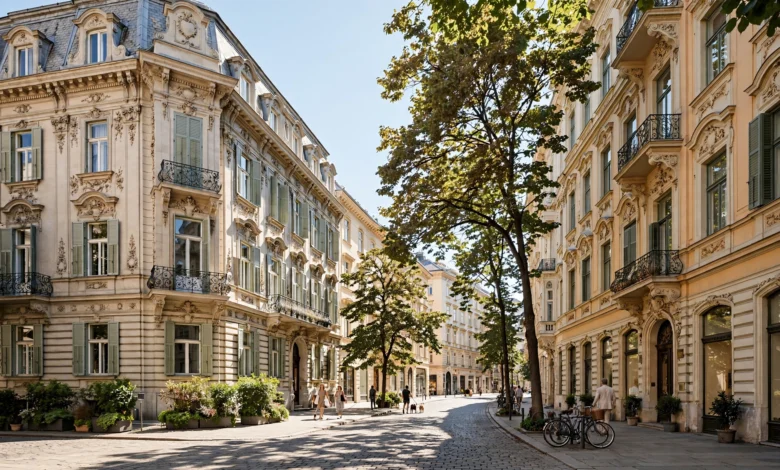
Vienna real estate market: stability amid European uncertainty captures exactly what’s setting Austria’s capital apart from many of its European peers heading into 2026. While cities across Southern Europe grapple with housing protests and runaway rent inflation, and other major capitals contend with political uncertainty and regulatory upheaval, Vienna has quietly moved through a measured 2022-to-2024 price correction and emerged into what analysts consistently describe as a stabilizing, recovering market, not a boom, but a genuine, steady turnaround.
The numbers back up the stability narrative. After a correction that saw prices ease rather than crash between 2022 and 2024, Vienna’s residential market has been stabilizing since early 2025, with several districts, including Donaustadt and Neubau, already showing renewed price increases in 2026. Forecasts for the year point to moderate, sustainable growth: RE/MAX’s real estate sentiment survey projects roughly 4.2% annual price growth in Vienna specifically, while more conservative estimates from Raiffeisen Research put Austria-wide growth closer to 2.5%. Neither figure suggests overheating, and both point toward a market finding a genuinely sustainable footing.
This article breaks down exactly what’s driving Vienna’s real estate stability amid broader European uncertainty, the current price and rental data, why the city continues attracting safe-haven capital from international buyers, and what this measured, predictable market means for anyone considering a purchase or investment. Whether you’re comparing Vienna against other European capitals or simply trying to understand why this city keeps appearing on stability and liveability rankings, here’s the complete, current picture.
Vienna Real Estate Market: The Current Price Data
Because multiple sources track Vienna’s property market with different methodologies and geographic scope, it’s useful to see the range of figures currently being reported for 2026.

| Source | Average Price | Measure | Forecast Growth |
|---|---|---|---|
| Pinyya market analysis | €6,700/m² | Price per square meter | N/A |
| Investropa | €430,000 | Average residential property price | N/A |
| RE/MAX RREFIX | N/A | Vienna-specific sentiment survey | +4.2% (2026) |
| Raiffeisen Research | N/A | Austria-wide residential | +2.5% (2026) |
| Kroy Real Estate | N/A | Condominiums specifically | +3% to +6% (2026) |
For a typical 70-square-meter apartment, this translates to roughly €470,000 at the citywide average price per square meter, though this varies considerably by district, with prime central locations like Innere Stadt and Neubau commanding significantly higher prices than outer districts such as Donaustadt or Brigittenau. Purchase price multiples, the number of years of annual net rent it would take to equal the purchase price, currently range between 22 and 35 depending on district and condition, with city-centre locations achieving the highest multiples.
Why Vienna’s Real Estate Market Has Achieved Stability
Several structural and policy factors explain why Vienna has navigated recent European economic turbulence with notably more stability than many comparable cities.
1. A Measured Correction, Not a Crash
Vienna’s property market experienced a genuine price correction between 2022 and 2024, driven primarily by rapidly rising interest rates that cooled the frenzied 2021-to-2022 boom period, when homes reportedly sold within days at prices 10% above asking. Crucially, analysts consistently characterize this as a correction rather than a crash, prices eased and stabilized rather than collapsing, a distinction that matters enormously for how confidently the market has been able to recover.
2. Falling Interest Rates Supporting Renewed Demand
The European Central Bank cut its key interest rate from 4.5% in 2023 to 2.5% as of April 2026, and mortgage rates in Austria have fallen accordingly. Buyers purchasing property in Vienna today are generally financing on considerably better terms than in 2022, and at stabilized prices rather than at the market’s previous peak, a combination that’s helping rebuild buyer confidence without reigniting speculative excess.
3. Structural Housing Undersupply Providing a Price Floor
CBRE has described Vienna’s residential supply conditions as “extremely tight,” with no sign of a trend reversal in near-term supply dynamics. RE/MAX experts have similarly warned that insufficient new construction could mean more demand meeting less supply, potentially increasing price pressure by 2027 and 2028. While this represents a genuine affordability challenge, it also provides a structural floor under prices that helps explain why Vienna’s correction remained a moderate adjustment rather than a deeper downturn.
4. Vienna’s Global Liveability Reputation
Vienna consistently ranks among Europe’s, and the world’s, most liveable capitals according to the Economist Intelligence Unit’s Global Liveability Index, a reputation built on stability, infrastructure quality, healthcare, education, and culture. This isn’t simply a marketing point, it’s a genuine driver of sustained international demand, as high-net-worth buyers and relocating professionals alike continue to view Vienna as a uniquely predictable, high-quality place to own property, even during periods of broader European uncertainty.
5. A Genuine Safe-Haven Positioning for International Capital
Austria has quietly evolved into a continental safe haven for ultra-high-net-worth buyers, according to recent luxury market analysis, offering a distinctive combination: more stable than Southern Europe’s lifestyle-driven markets, more discreet than Switzerland’s heavily regulated enclaves, and more culturally magnetic than many Northern European capitals. Austria’s luxury segment specifically benefits from limited supply, heritage architecture, and stringent development controls, factors that naturally support both prestige and long-term price stability rather than speculative volatility.
6. A Tight, Well-Managed Rental Market
Vienna’s rental vacancy rate sits at just 1.2%, an extremely tight figure that reflects consistent, structural demand rather than speculative rental investment activity. Gross yields on Viennese tenement buildings currently run between 2.5% and 4.5% depending on district, condition, and rental structure, modest by international standards but consistent with a market prioritizing long-term capital preservation over aggressive yield-chasing.
How Vienna Compares to European Uncertainty Elsewhere
Placing Vienna’s stability in context requires understanding what’s happening in comparable European markets experiencing considerably more turbulence.
- Spain’s major cities, including Madrid and Barcelona, have faced mass protests over spiraling rents and housing costs through 2026, alongside politically contentious regulatory battles over tourist rental restrictions.
- The UK market has shown national house price growth of just 1.3% to 1.5%, with some forecasts suggesting a possible 2.0% national decline in 2026 amid weaker buyer confidence and elevated mortgage rates.
- Several European capitals continue grappling with political uncertainty that directly affects property market confidence, whether through housing policy debates, rent control battles, or broader economic instability.
Against this backdrop, Vienna’s story, a measured correction followed by steady, forecast-confirmed stabilization, growth projections in the low single digits rather than double-digit swings in either direction, and a consistent liveability reputation, stands out as a genuinely differentiated value proposition for buyers and investors specifically seeking predictability over speculative upside.
Which Vienna Districts Are Leading the Recovery
Vienna’s stabilization hasn’t been perfectly uniform across all 23 districts. Several specific areas are showing the clearest signs of renewed momentum.
- Donaustadt (22nd district) has already shown slight price increases in 2026, benefiting from newer housing stock and continued infrastructure development along the Danube.
- Neubau (7th district) is also showing early signs of renewed growth, reflecting its established reputation as one of Vienna’s more design-forward, centrally located neighborhoods.
- Leopoldstadt is projected to see prices rise approximately 4% to 6% in 2026, among the strongest growth rates of any Vienna district, supported by continued transport access, new housing supply, and steady rental demand.
- Landstraße is forecast for roughly 4% to 5% growth, while Brigittenau is projected in a similar 4% to 6% range, both benefiting from better relative value than fully prime districts like Innere Stadt while still offering solid transport connectivity and rental demand.
The common thread across these outperforming districts is that buyers are increasingly finding useful transport links, newer housing stock, and stronger relative value in these areas compared to Vienna’s most prime, already fully priced central districts.
What Buyers Should Understand About Vienna’s Market Right Now
Vienna’s stability doesn’t mean the market is simple or effortless to navigate. A few realistic expectations matter for anyone considering a purchase.
- Expect a longer sales process than during the 2020-to-2022 boom. A correctly priced residential property in Vienna typically needs about 90 to 130 days to sell, with small apartments moving faster than larger, more expensive homes, though the full practical range spans roughly 70 to 160 days depending on district and condition.
- Negotiation remains standard practice. Most residential properties in Vienna currently sell about 3% to 6% below asking price, meaning a realistic sale-to-asking ratio runs roughly 94% to 97% for ordinary listings, with only 10% to 20% of homes selling at or above asking price.
- Vienna is not a bargain market, but it’s meaningfully less overheated than 2020 to 2022. Buyers today generally have more room to negotiate and more time to conduct due diligence than during the previous boom cycle, even as absolute prices remain elevated by historical standards.
- Financing conditions have genuinely improved. With the ECB’s rate cuts flowing through to Austrian mortgage rates, buyers purchasing now often secure meaningfully better financing terms than those who bought at the 2022 peak.
- Watch the specific district and property type closely. Good apartments in practical, well-connected districts continue moving at a reasonable pace, while overpriced luxury homes tend to sell more slowly, meaning realistic pricing matters more than ever for sellers and represents a genuine opportunity for well-informed buyers.
For readers who want to track Vienna’s official market data directly, Statistics Austria’s residential property price index provides regularly updated national and Vienna-specific price data, while the Economist Intelligence Unit’s Global Liveability Index offers the internationally recognized ranking that continues underpinning much of Vienna’s reputation as a stable, high-quality place to own property.
What This Means for Sellers and Investors
For sellers:
- Realistic, district-appropriate pricing matters considerably more now than during the 2021-to-2022 boom, when nearly any listing sold quickly regardless of asking price
- Well-located, reasonably priced apartments in practical districts continue attracting solid buyer interest, while overpriced luxury properties face a notably slower path to sale
For investors:
- Vienna’s modest gross yields (2.5% to 4.5%) reflect its positioning as a capital preservation and long-term stability market rather than a high-yield income play, an important distinction for investors setting realistic return expectations
- The extremely tight rental vacancy rate of 1.2% provides strong occupancy confidence for buy-to-let investors, even as regulatory frameworks around Viennese rental housing remain more structured than in many comparable European cities
- International, safe-haven-driven demand continues supporting Austria’s luxury segment specifically, a distinct investment thesis from the broader residential market’s more moderate, steady growth profile
Frequently Asked Questions
What is the average property price in Vienna in 2026?
Estimates vary by source and methodology, with figures ranging from approximately €6,700 per square meter to an average overall residential price of around €430,000, translating to roughly €470,000 for a typical 70-square-meter apartment at the citywide average.
Is Vienna’s real estate market currently rising or falling?
Vienna’s market experienced a price correction between 2022 and 2024 but has been stabilizing since early 2025, with several districts already showing renewed increases in 2026 and forecasts pointing to moderate growth of roughly 2.5% to 6% depending on the specific measure and property segment.
Why is Vienna considered a stable real estate market compared to other European cities?
Vienna benefits from a measured, non-catastrophic price correction rather than a crash, falling interest rates supporting renewed buyer confidence, structurally tight housing supply providing a price floor, and a consistent global liveability reputation that continues attracting international, safe-haven-driven demand even amid broader European economic and political uncertainty.
Are Vienna rental yields good for investors?
Vienna’s gross rental yields, typically 2.5% to 4.5% depending on district and property condition, are modest compared to higher-yield emerging markets, reflecting Vienna’s positioning as a long-term capital preservation market rather than a high-income investment destination.
Conclusion
Vienna real estate market: stability amid European uncertainty describes a city that’s navigated a measured correction, falling interest rates, and structurally tight supply into a genuinely stabilizing, forecast-confirmed recovery, with growth projections in the low single digits for 2026 rather than the double-digit swings, in either direction, seen in more volatile European markets. Vienna’s consistent ranking among the world’s most liveable cities, its emerging reputation as a continental safe haven for international capital, and its tight, well-managed rental market all reinforce the same underlying story: predictability and long-term value preservation rather than speculative upside. For buyers and investors weighing Vienna against more turbulent European alternatives, whether Spain’s protest-driven housing crisis, the UK’s uncertain national trajectory, or other capitals facing their own political and regulatory headwinds, Austria’s capital offers something increasingly rare on the continent right now: a real estate market where the story genuinely is stability, not spin.