Portland Housing Market 2026: Positive Signs Point to a Promising Rebound
Portland housing market update: rising sales activity, easing mortgage rates, and more listings point to early signs of recovery in 2026.

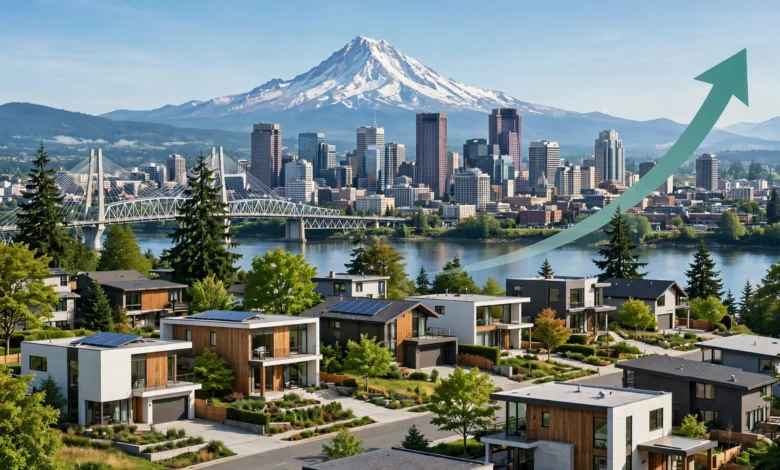
The Portland housing market has spent the past few years in a holding pattern that’s tested the patience of buyers, sellers, and agents alike. After the sharp cooldown that followed the pandemic-era boom, Portland home values drifted sideways, mortgage rates stayed elevated, and transaction volume slowed to a crawl. But heading through 2026, something genuinely different is showing up in the data: more listings, more sales, easing rates, and buyers who are re-engaging after years of sitting on the sidelines.
This isn’t a return to the frenzied bidding wars of 2021, and nobody serious about the local market is predicting one. What’s emerging instead is quieter and, in some ways, more meaningful: a market finding its footing after an extended stretch of uncertainty. Home prices have largely stopped declining and stabilized in the low to mid-$500,000s. Sales volume is ticking upward. And the mortgage rate lock-in effect that kept so many homeowners frozen in place is finally starting to loosen.
This article walks through what the current price, inventory, and sales data actually show for Portland, why analysts are increasingly using words like “turning a corner” rather than “stabilizing at a low,” which factors are driving the shift, and what it all means depending on whether you’re buying, selling, or simply watching the market from a distance. We’ll pull from multiple independent sources, including Zillow, Redfin, and local market reports, to give an accurate, balanced picture rather than an overly optimistic or overly cautious one.
Portland Housing Market Overview: Where Prices Stand in 2026
Before getting into the recovery signals, it’s worth establishing exactly where prices sit right now, since figures vary somewhat depending on the data source and exact geographic boundary used.

Median and Average Home Values
Multiple sources converge on a similar range for Portland home values in 2026:
- Zillow’s Home Value Index puts the average Portland home value at $534,270 as of late July 2026, down a modest 0.1% over the past year
- Redfin reported a median sale price of $536,000 over the three months ending July 2026, down 2.6% compared to the same period a year earlier
- Other local market reports place the broader Portland metro median between $529,000 and $549,000, with year-over-year appreciation described as flat to modestly positive, around 1% to 2%
- One monthly tracking report from late 2025 cited a Portland median closer to $515,000, reflecting a somewhat different measurement window
The takeaway across these slightly varying figures is consistent: Portland home prices have essentially stopped falling and are hovering in a narrow, stable range rather than continuing the sharper corrections seen in 2023 and 2024.
Days on Market and Buyer Activity
Redfin data shows homes in Portland selling after roughly 14 days on market currently, actually slightly faster than the 15 days recorded a year earlier, with homes receiving an average of two offers. Other local reports citing broader average market times put typical listings between 55 and 80 days, a difference that likely reflects the gap between how quickly homes go to pending status versus total time from initial listing to closing. Either way, the directional signal matters more than the exact number: buyer engagement has been picking up rather than continuing to fade.
Signs of Recovery in the Portland Real Estate Market
This is where 2026 genuinely looks different from the previous two years, and where the “recovery” framing starts to make real sense.
Sales Volume Is Increasing
Redfin recorded 2,302 homes sold in Portland in July 2026, up from 2,212 during the same month a year earlier. That’s a meaningful increase in transaction activity, particularly after several years where sales volume had been sluggish across most of the metro. More transactions closing, even without dramatic price movement, is one of the clearest signs that buyer confidence is genuinely returning rather than just holding steady.
Mortgage Rates Are Easing From Recent Peaks
Mortgage rates have trended down for much of the past year, with some reports pointing to the best rates seen since 2025 emerging in recent months. While rates remain elevated compared to the ultra-low pandemic era, hovering in the 6.5% to 7.0% range according to several local sources, the direction of movement matters. Declining rates, even gradually, meaningfully improve monthly affordability and tend to draw hesitant buyers back into active house-hunting.
The Mortgage Rate Lock-In Effect Is Loosening
For years, homeowners sitting on mortgage rates from the 3% era had little financial incentive to sell and take on a new loan at 6% or 7%. That dynamic, commonly called the lock-in effect, has been a major contributor to Portland’s persistently low inventory. Local market reports now describe this effect as genuinely easing, with more homeowners deciding to move forward with life plans, relocations, downsizing, upgrading, that they’d been postponing. This shift is adding real, meaningful supply back into the market rather than relying solely on new construction to fill the gap.
Inventory Has Risen to More Balanced Levels
Housing inventory across the Portland metro has stabilized at approximately 3.0 months of supply, a level generally considered close to balanced rather than heavily favoring either buyers or sellers. This represents a genuine shift from the tight, seller-dominated conditions of a few years ago, giving buyers real time to negotiate, conduct thorough inspections, and make more deliberate decisions rather than rushing to compete in bidding wars.
Buyer Traffic Is Trending Higher
Several local market reports through 2025 and into 2026 have noted higher-than-normal buyer traffic alongside higher-than-average inventory, a combination that, while not producing dramatic price appreciation yet, points toward a market absorbing supply at a healthy pace rather than sitting stagnant.
Why Portland Hasn’t Seen a Sharp Price Correction
Given the years of cooling conditions, it’s worth explaining why Portland has avoided the kind of sharp price decline some observers expected.
A Crash Was Never Really on the Table
Local analysts have been consistent on this point for over a year: current indicators point toward continued stability rather than a dramatic downturn. Even during the slower years, distressed inventory and forced sales remained limited, which historically is a key ingredient in any genuine price crash. Without that ingredient present, prices had a natural floor even as demand softened.
New Construction Dynamics Created an Unusual Pattern
One notable trend from the past year: strong homebuilding activity nationally, though less pronounced in Portland specifically, led to a period where new homes became cheaper than existing homes for the first time in decades in some markets. Builders facing higher financing and material costs have had less incentive to keep building until existing supply sells through, which has kept a natural check on how much new inventory floods the market at once.
Population and Migration Trends Continue Supporting Demand
Oregon continues attracting out-of-state buyers from California, Washington, and beyond, providing a steady demand floor underneath the broader market even during slower stretches. This ongoing migration pattern is one of the structural factors keeping Portland from experiencing the kind of demand collapse that would be needed to trigger a genuine price correction.
Portland Neighborhood and Regional Variations
Portland’s recovery signals aren’t distributed evenly, and understanding regional variation matters for anyone evaluating a specific purchase or listing.
Portland City Proper
Some 2026 forecasts predicted essentially flat pricing for Portland city proper itself, a 0.0% projected change, which industry commentators actually framed as an improvement given the price declines of recent years.
Clackamas and Washington County Suburbs
Nearby suburban counties were forecast to see modest gains, around 0.5% price increases, slightly outperforming the city core as buyers seek relative value just outside Portland’s urban boundaries.
Bend and Central Oregon
Bend and the broader Central Oregon region remain considerably more competitive and premium-priced, with medians near $775,000, driven by strong demand from buyers seeking outdoor recreation access and lifestyle amenities rather than urban proximity.
Salem and the Mid-Willamette Valley
Salem has emerged as one of Oregon’s fastest-growing real estate markets in 2026, with a median price around $450,000, considerably more affordable than Portland proper. Its central location, within driving distance of both the coast and mountain resorts, continues attracting buyers priced out of the Portland metro.
What Portland’s Recovery Signals Mean for Buyers
If you’re considering a purchase in Portland right now, a few practical points are worth keeping in mind:
- Take advantage of the current inventory levels. With supply sitting near 3.0 months, a genuinely balanced range, you have more room to negotiate on price or terms than buyers had just a couple of years ago
- Don’t wait indefinitely for prices to drop further. With sales volume rising and the lock-in effect easing, the conditions that produced price declines in 2023 and 2024 are shifting, and further meaningful drops look less likely
- Look at homes that have sat longer on the market. Sellers of properties with extended market time are often more willing to negotiate on price or closing terms
- Consider nearby suburbs and secondary markets like Salem or Washington County if Portland proper pricing is outside your budget
What This Means for Sellers
Sellers should treat the current environment as a genuine opportunity, but one that requires more effort than during the boom years. Rising buyer traffic and easing mortgage rates are drawing more serious shoppers back into the market, and increased sales volume confirms that homes are moving. That said, staging, accurate pricing, and thorough preparation matter considerably more than they did when almost any listing generated competing offers. With roughly 3.0 months of inventory available, buyers have comparison points, and overpriced listings risk sitting while well-prepared, realistically priced homes continue to sell at a healthy pace.
Portland Housing Market Forecast for 2027 and Beyond
Most local analysts expect the current stabilization to gradually give way to modest, positive appreciation as 2027 approaches, assuming no major economic shocks disrupt the trajectory. Continued population growth, potential further easing in mortgage rates if inflation remains under control, and a slow return of buyer confidence are all cited as factors that could support low single-digit annual price growth, consistent with longer-term historical averages for the region. For authoritative national context on how Portland’s recovery signals compare to broader housing trends, Freddie Mac’s mortgage rate and housing research provides regularly updated, reliable data worth cross-referencing against local reports (Freddie Mac: Primary Mortgage Market Survey). For deeper detail on Portland-specific price and inventory metrics, Redfin’s data center offers granular, frequently updated local housing statistics (Redfin: Portland Housing Market Data).
Conclusion
Portland’s housing market in 2026 isn’t staging a dramatic comeback, but it is showing genuine, measurable signs of recovery after years of cooling and uncertainty. Sales volume is rising, mortgage rates are easing from recent highs, the long-standing rate lock-in effect is finally loosening, and inventory has settled into a more balanced range near 3.0 months of supply. Prices themselves have largely stopped declining and stabilized in the low to mid-$500,000s across most of the metro, with modest appreciation forecast to return by 2027 if current trends hold. Buyers currently have more negotiating room than they’ve had in years, while sellers who price accurately and prepare their homes well continue to find willing buyers. Taken together, these signals point toward a market that’s quietly, steadily finding its footing rather than one still searching for a bottom.