Georgia Real Estate Trends: 8 Booming Atlanta Suburbs Buyers Can’t Ignore
Georgia real estate trends show Atlanta's suburbs leading growth in 2026, driven by jobs, migration, and new development across the metro.

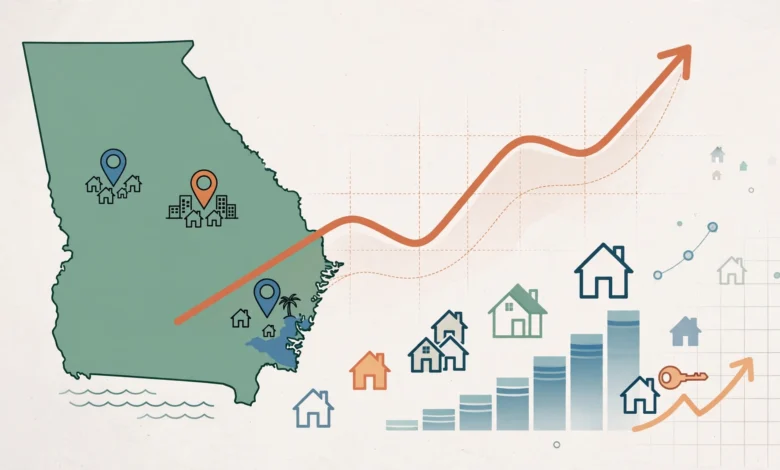
Georgia real estate trends in 2026 point squarely toward one story: the action has shifted from downtown Atlanta to the ring of suburbs surrounding it. While the city’s core neighborhoods, places like Buckhead, Midtown, and Sandy Springs, continue performing steadily, the fastest population growth, new construction, and buyer demand are concentrated in suburban counties like Gwinnett, Forsyth, Cherokee, and Paulding.
This shift isn’t random. Metro Atlanta added more than 78,000 new jobs in the twelve months leading into late 2025, and major employers, including Rivian’s ongoing manufacturing build-out and Microsoft’s planned campus in Midtown, are pulling in thousands of high-wage workers who need somewhere to live. Combined with a continued wave of domestic migration from higher-cost states like California, New York, and Florida, the result is sustained pressure on suburban housing markets that shows no sign of slowing.
This article breaks down the Georgia real estate trends driving Atlanta’s suburban boom, walks through the specific suburbs seeing the strongest growth right now, and covers what buyers, sellers, and investors should understand about pricing, inventory, and where the smartest opportunities currently sit across the metro area.
Why Atlanta’s Suburbs Are Booming in 2026
Before looking at individual suburbs, it helps to understand the broader forces reshaping Georgia’s real estate market this year.


Strong Job Growth Is Fueling Housing Demand
Metro Atlanta’s employment growth has consistently outpaced many other major Southeastern metros. Major corporate expansions, including Rivian’s manufacturing operations east of the city and new film and production facilities across the region, continue bringing well-paying jobs into the metro area. This employment growth translates directly into housing demand, particularly in suburban counties positioned within a reasonable commute of these major job centers.
Population Growth Continues Outpacing the National Average
Georgia’s population reached an estimated 11.3 million as of mid-2025, up 5.5% from the 2020 census baseline, and the state’s Governor’s Office of Planning and Budget projects continued growth toward 13 million residents by 2060. Atlanta consistently ranks among the top metro areas nationally for domestic inbound migration, with residents relocating from higher-cost states drawn by relative affordability and strong job availability.
Domestic Migration Remains a Major Driver
While international migration into Georgia is expected to soften slightly in 2026, domestic migration continues to more than offset that shift. Buyers and renters relocating from California, New York, and Florida in particular have contributed meaningfully to demand in suburban Atlanta communities, where they often find significantly more home for their money compared to their previous markets.
A More Balanced Market Is Emerging
After years of intense seller-favored conditions, the broader Atlanta market is showing signs of stabilization. Inventory across the metro region has climbed to roughly 17,300 active listings, and the market is edging toward more balanced conditions between buyers and sellers, with average sale prices adjusting within a modest 2% to 3% range rather than the sharp swings seen in previous years.
For continuously updated data on metro-wide housing statistics, the Atlanta REALTORS® market reports compiled from First Multiple Listing Service (FMLS) data offer one of the most reliable sources for tracking monthly trends across the metro’s key counties.
Atlanta’s Fastest-Growing Suburbs to Watch
Here’s a closer look at the specific suburban markets standing out in current Georgia real estate trends, based on population growth, new construction activity, and buyer demand.
1. Gwinnett County
Gwinnett County remains one of metro Atlanta’s fastest-growing suburban areas, particularly in the rental sector. Expanding job centers, growing population, and strong renter demand continue to make the county attractive to both residents and investors, and the county’s size gives it a diverse mix of established neighborhoods and newer development corridors.
2. Forsyth County (Cumming)
Cumming and the broader Forsyth County area continue to attract professional families drawn by strong school districts and well-developed parks infrastructure. Growth metrics suggest properties here are likely to maintain solid value resilience, making it a frequent standout on investor watchlists across the northern suburbs.
3. Cherokee County (Woodstock and Holly Springs)
Cherokee County communities like Woodstock and Holly Springs have seen sustained growth driven by newer housing developments and continued demand from families seeking more space than intown Atlanta typically offers at comparable price points.
4. Chamblee
Chamblee has transformed over the past decade from a quiet community into a genuinely urban suburb, with new apartments, townhomes, and mixed-use development reshaping the area. Its location directly on MARTA transit lines and proximity to major job centers like Buckhead and Midtown make it especially appealing to young professionals and first-time buyers who want suburban pricing without giving up urban convenience.
5. Braselton
Further out along the Interstate 85 corridor, Braselton has become one of the fastest-growing towns among the outer Atlanta suburbs. A growing number of master-planned communities have made it a popular destination for families specifically seeking newer construction and modern amenities at a lower price point than closer-in suburbs.
6. Paulding and Bartow Counties
West and northwest of the city, Paulding and Bartow Counties rank among the fastest-growing areas in the entire metro, fueled significantly by remote workers and new industrial park development. Their relative affordability compared to northern suburbs makes them attractive to buyers seeking more space for their budget.
7. Milton and Suwanee
Both Milton and Suwanee continue drawing strong buyer interest thanks to a combination of lifestyle amenities, quality schools, and long-term value retention, making them consistent favorites among buyers prioritizing family-oriented suburban living.
8. Midtown and West Midtown (Intown Alternative)
While technically inside city limits rather than a traditional suburb, Midtown and West Midtown deserve mention because they’re absorbing significant luxury condo and townhome development, largely driven by empty-nest buyers downsizing from larger suburban homes while staying within the broader metro area’s amenity base.
What’s Driving Demand in These Specific Areas
A few consistent themes explain why these particular communities are outperforming broader market averages.
- Transit access: Suburbs connected to MARTA or major interstate corridors consistently see stronger demand than more isolated communities.
- New construction availability: Areas with active master-planned communities and new-build inventory attract buyers who want modern layouts and better energy efficiency compared to older housing stock.
- School district quality: Family-oriented suburbs with strong public school ratings continue commanding premium demand relative to comparable areas with weaker school reputations.
- Relative affordability: Buyers priced out of intown neighborhoods or northern suburbs like Sandy Springs and Brookhaven are increasingly looking further out to counties like Paulding, Bartow, and outer Gwinnett for better value.
- Employment proximity: Suburbs within a reasonable commute of major job centers, including the ongoing Rivian build-out and Midtown’s expanding tech presence, see sustained demand tied directly to employment growth.
Pricing and Market Conditions Across the Metro
Understanding current pricing dynamics helps put the suburban growth story in proper context.
Modest, Sustainable Price Growth
Rather than the dramatic price surges seen in recent years, 2026 forecasts point toward more modest, sustainable appreciation. Atlanta itself is projected to see growth in the 0.5% to 2.0% range, while some other Georgia cities like Athens are expected to see stronger gains of 4% to 6%, reflecting more localized demand dynamics outside the immediate metro core.
Rental Market Strength
Atlanta’s multifamily rental sector is showing renewed momentum after several years of absorbing heavy apartment construction. Industry projections suggest effective rents in Atlanta could grow by roughly 4% in 2026, positioning the metro among the stronger-performing rental markets nationally as a slowing development pipeline helps stabilize vacancy rates.
Mortgage Rate Environment
Mortgage rates are expected to hover in the low-to-mid 6% range through much of 2026. While this remains elevated compared to the ultra-low rates of previous years, real estate professionals across the metro generally advise buyers not to wait for further rate drops, since a subsequent decrease would likely flood the market with additional competing buyers and offset any savings from lower rates with higher purchase competition.
National Rankings Reflect Continued Strength
Atlanta has ranked among the top markets nationally for overall real estate prospects in recent industry reports, trailing only a small handful of metros like Nashville, Dallas-Fort Worth, and Austin. Some forecasts have gone further, naming Atlanta among the top two markets nationally for combined expected home-price appreciation and sales growth, a strong signal for continued investor interest across the metro’s suburban submarkets.
For a broader national perspective on how Atlanta compares to other growing metros, Realtor.com’s housing market forecasts provide comparative data across major U.S. cities that helps contextualize Georgia’s performance against the national picture.
Challenges Buyers Should Keep in Mind
Despite the strong growth narrative, a few real challenges are worth factoring into any decision to buy in the Atlanta suburbs right now.
- Rising insurance costs. Property insurance premiums across Georgia have continued climbing sharply, adding meaningfully to the total cost of homeownership beyond just the mortgage payment.
- Affordability pressure for first-time buyers. Even with modest price growth, elevated interest rates combined with rising prices continue to outpace local wage growth in many submarkets, making entry-level homeownership harder to reach.
- Uneven growth across submarkets. Not every suburb is growing at the same pace, and buyers should research specific school districts, commute times, and local development plans rather than assuming metro-wide trends apply evenly everywhere.
- Competition in desirable school districts. Family-oriented suburbs with top-rated schools often see faster-moving inventory and less room for price negotiation compared to less competitive areas.
Frequently Asked Questions
Which Atlanta suburb is growing the fastest in 2026?
Several suburbs are competing for that distinction depending on the metric used, but Gwinnett, Forsyth, Cherokee, Paulding, and Bartow Counties consistently rank among the fastest-growing areas in terms of population growth and new construction activity.
Is now a good time to buy in Atlanta’s suburbs?
Real estate professionals generally suggest that waiting for interest rates to drop further could backfire, since lower rates typically bring more buyers into the market and increase competition. Securing a favorable price now, with the option to refinance later if rates decline, is a commonly recommended strategy.
Are home prices expected to rise significantly in Atlanta in 2026?
Most forecasts point toward modest, sustainable growth rather than sharp increases, with Atlanta specifically projected to see price appreciation in the 0.5% to 2.0% range, while some other Georgia cities may see somewhat stronger gains.
Conclusion
Georgia real estate trends in 2026 make clear that Atlanta’s growth story has shifted decisively toward its suburbs. Strong job creation, sustained domestic migration, and a more balanced inventory environment are combining to fuel demand across communities like Gwinnett, Forsyth, Cherokee, Chamblee, Braselton, and the Paulding-Bartow corridor, each offering a different mix of affordability, school quality, and commute convenience. While rising insurance costs and affordability pressure remain real challenges, the combination of continued employment growth, national market rankings placing Atlanta among the top metros for expected appreciation, and steady rental demand suggests the metro’s suburban momentum is likely to continue well beyond this year.